The Climate Detectives project invites students to work in teams to investigate, learn about, and protect our planet Earth. To do this, the young detectives must identify a local problem, study it using real satellite images and their own field measurements, and finally propose actions to adapt, help reduce, or monitor this problem. Students will also have the opportunity to take part in some of our activities to discover the mechanisms of the Earth and its climate.
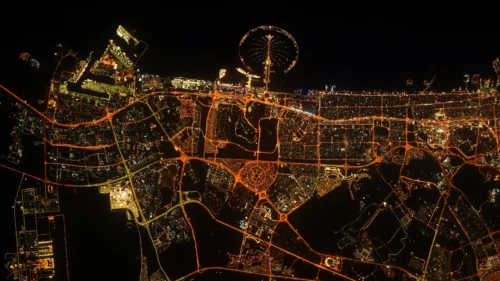
Studying light pollution from space
In France, light pollution has increased by more than 90% over the past 25 years, creating domes of light visible almost everywhere in the country. In addition to obscuring part of the night sky, this has a significant impact on biodiversity, particularly on the movements of nocturnal wildlife, which accounts for 64% of invertebrate species and more than 30% of vertebrates.
To show how satellites can be used to study light pollution, CNES, through its ESERO France office, organized an online conference on Thursday, December 11, 2025, entitled: “Light pollution as seen by satellites.” This web conference was given by Marie-Odile Marché, an Earth observation applications engineer at CNES’s Earth Observation Laboratory (Lab’OT), who presented how satellites observe the Earth at night and how they are used to study the evolution of light pollution.
The conference was attended by more than 750 students from CM1 to high school. If you missed it or would like to watch it again, it is now available in French for replay below or in the CNES video library.