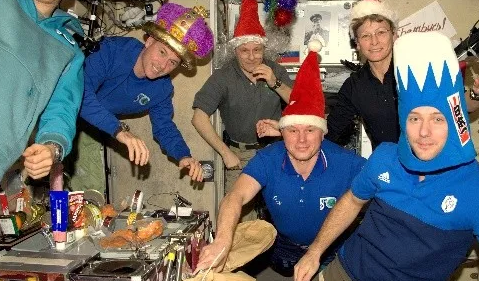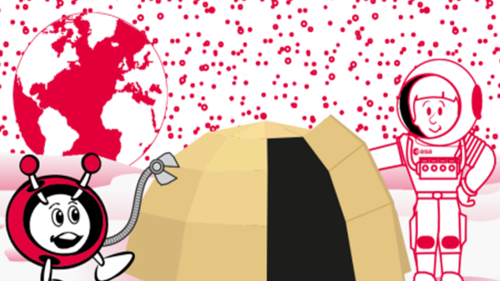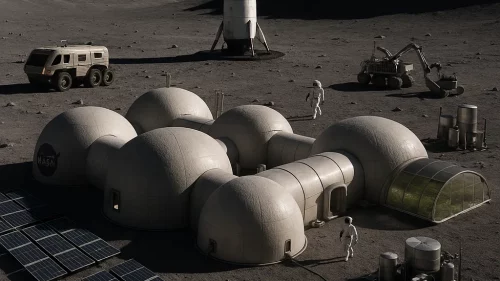
To introduce young people to the challenges that lunar explorers will face, CNES and ESA propose the educational projects Mission X and Moon Camp. With the first, students in cycles 1 to 4 will discover the training and daily activities of astronauts. In the second, primary and secondary school students are invited to build their own space base, taking into account the constraints of the Moon or the celestial body chosen as their host.
Exploring space with the help of AI
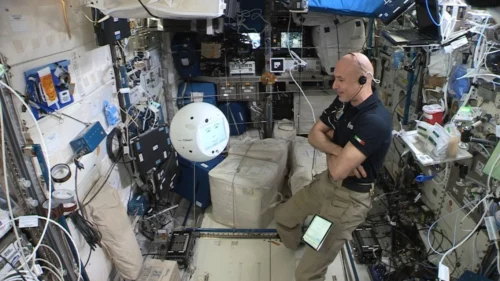
In recent years, artificial intelligence (AI) in all its forms has been the focus of public and professional attention. While it is proving very useful in astronomy for data processing and analysis, it will certainly play a major role for astronauts in future space exploration. Whether in support of astronauts, for medical assistance or for controlling rovers, AI will play a very important role in the return of humans to the Moon, and perhaps in journeys to Mars.
In order to present the work carried out by CNES in designing a virtual assistant for astronauts, CNES, through its ESERO France office, organised an online conference on Thursday 5 February 2026 entitled: ‘AI serving astronauts’. Denis Baron, Digital Manager and Spaceship Supervisor at CNES, presented AMAIA, the Multifunctional Assistant for Astronauts powered by AI/Astronaut, a potential AI travel companion for astronauts on future lunar or Martian missions.
This conference brought together more than 1,000 students from CM1 to High school. If you missed it or would like to watch it again, it is now available for replay in French below or on the CNES video library.