Send your drawing into space!
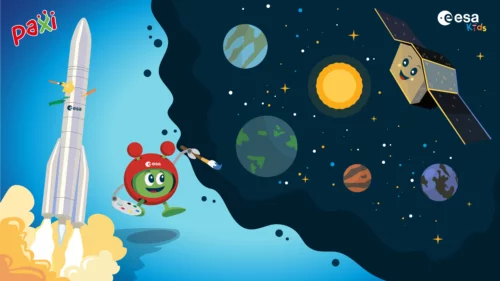
This new art competition, organised by ESA as part of the preparations for the launch of the PLATO satellite, invites children up to 12 years old to create an illustration inspired by the PLATO mission. A jury of ESA experts, chaired by our alien mascot, Paxi, will select the most inspiring artwork. The winning illustration will be printed on a huge sticker to be placed on the fairing of the Ariane 6 rocket, which will launch the satellite into space in early 2027.
To do so, please read the competition rules carefully, be creative and show us your imagination through art! Entries must be submitted exclusively by an adult via the dedicated form by July 1, 2026, at 11:59 p.m. (CEST). Only entries that comply with all the competition rules will be accepted.
Special prizes await the winners:
1st prize
- The winning design will be displayed on the Ariane 6 rocket that will carry PLATO into space.
- The winner, accompanied by a parent or legal guardian, will be invited by ESA to watch the live launch of PLATO from ESA’s ESOC centre in Germany in early 2027.
Other prices
- The 12 best drawings, including the first prize winner, will be featured in the PLATO 2027 calendar, which will be available to download for free online.
- The 30 best drawings will receive an ESA goody bag, and their artwork will be displayed online in a dedicated image gallery on the ESA Kids website and on the official ESA PLATO web pages.
- All participants will receive a certificate of participation.
Are you ready to join us on an adventure aboard the Ariane 6 rocket, which will carry PLATO to explore planets orbiting other stars?
PLATO mission
Since the discovery of the first planet orbiting a Sun-like star in 1995, the research and study of these exoplanets have become one of the most important fields of research in astronomy. With over 6,000 known exoplanets, astronomers have discovered some truly exotic worlds, such as planets orbiting multiple stars, or giant planets very close to their star and extremely hot (over 1,000 degrees!).
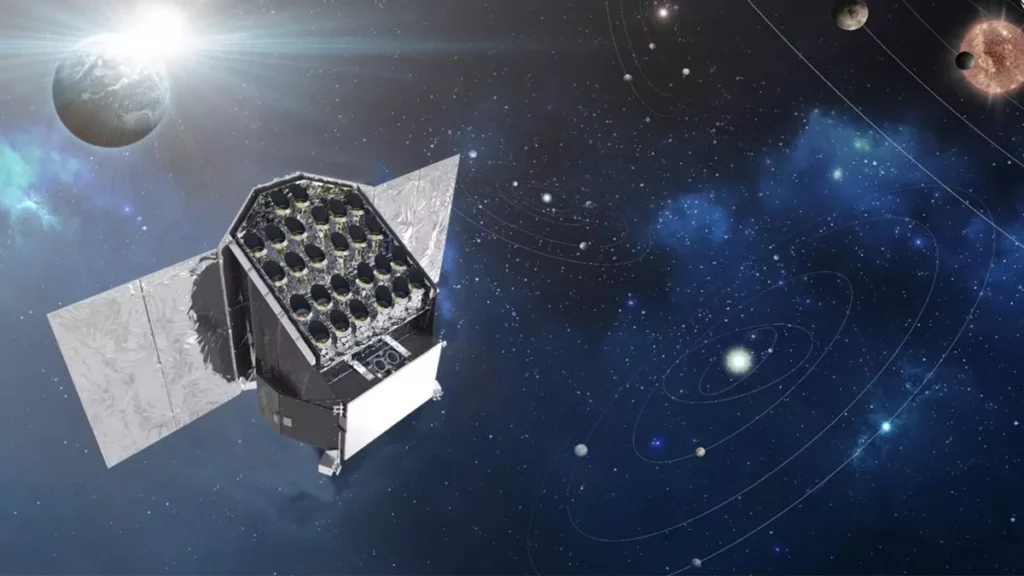
However, Earth-like exoplanets remain very difficult to observe and are therefore poorly studied. To address this, ESA will launch the PLATO (PLAnetary Transits and Oscillations of stars) telescope into space in early 2027. Equipped with 26 cameras, this satellite will aim to observe several thousand stars with the aim of improving our knowledge of known exoplanets and, who knows, discovering new Earth-like worlds.