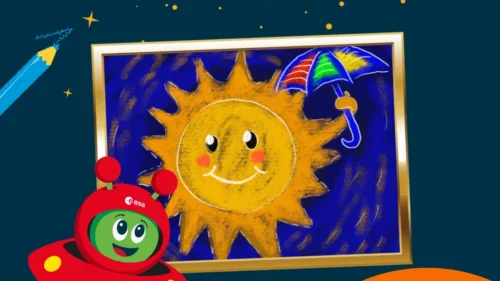
The European Space Agency (ESA), through its ESA Kids programme, is running the Space Gallery Competition. This competition aims to showcase young people’s work on the theme of space. Entries can be in a variety of formats (drawings, paintings, models, etc.) to give young artists free rein for their imagination and creativity. Each month, a new theme is selected by the ESA. For the April 2026 edition, the ESA has chosen «Space Weather» as its theme.
Studying the solar wind
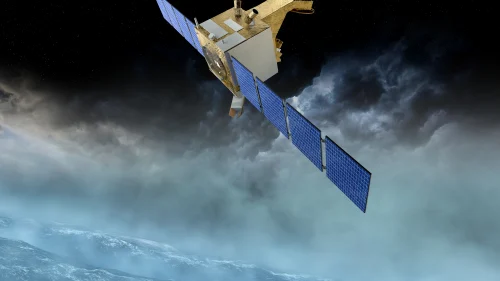
On April 9, 2026, the new SMILE satellite was launched by the European VEGA-C rocket. This mission, led by the ESA in collaboration with the Chinese Academy of Sciences, aims to study the interactions between the solar wind and Earth’s magnetosphere.
Indeed, the Sun constantly ejects particles into space, such as protons. These particles are electrically charged and, when they reach Earth, interact with the Earth’s magnetic shield. Furthermore, the Sun does not always eject the same quantity of particles. It follows an approximately 11-year cycle during which there are periods of calm and periods of intense activity. 2025 was, for example, a very intense year for the Sun.
Thus, during major solar flares, so many particles reach Earth that some pass through the Earth’s magnetic shield. They are then redirected towards the poles and interact with atoms in the atmosphere, such as nitrogen or oxygen. These atoms absorb the energy from these particles and release it, producing light. This is known as the Northern Lights (in the north) and the Southern Lights (in the south).
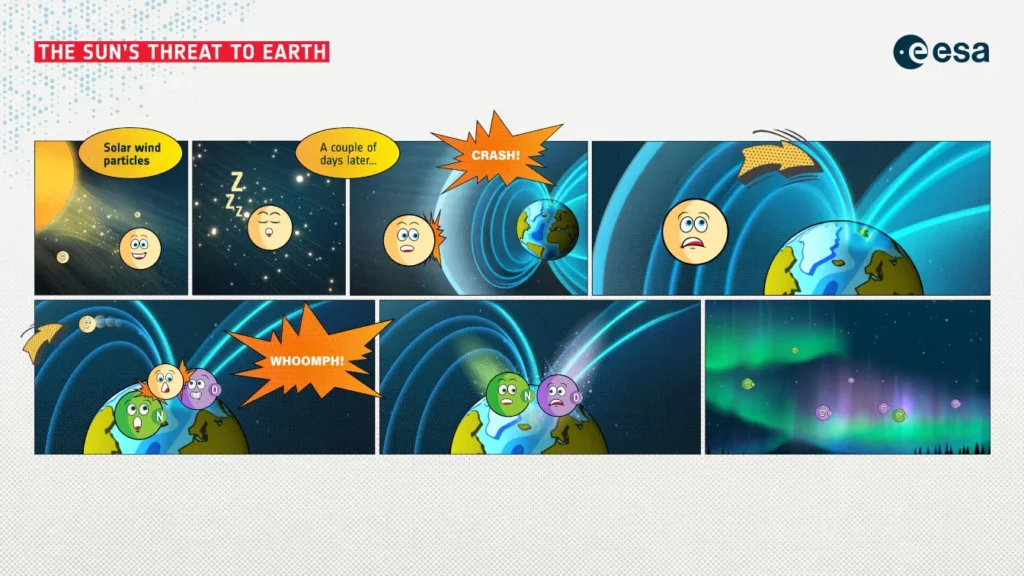
The Smile satellite will therefore help answer many questions, providing comprehensive images of how the Earth reacts to this space weather. What do you think Smile will observe? Will it explore the auroras, dancing amongst the lights? Or perhaps it will hide beneath the Earth’s umbrella, searching for tiny raindrops of particles slipping through?
The ESA will select the winners of the competition, whose works will be exhibited in the “Paxi Space Gallery” and who will receive a special prize!
How can I take part?
To participate in the February 2026 competition, your creations must be sent to ESA before 30 April 2026. You can submit them directly on the competition page by clicking on this link, or you can send them by post to: ESA Education, ESTEC, Keplerlaan 1, PO Box 299 NL-2200 AG Noordwijk, The Netherlands.
Participants must be under 18 years of age. Please note that entries sent by post will not be returned, and you will not receive confirmation of receipt. Selected participants will be contacted by ESA.
Good luck to everyone! We look forward to seeing your creations!
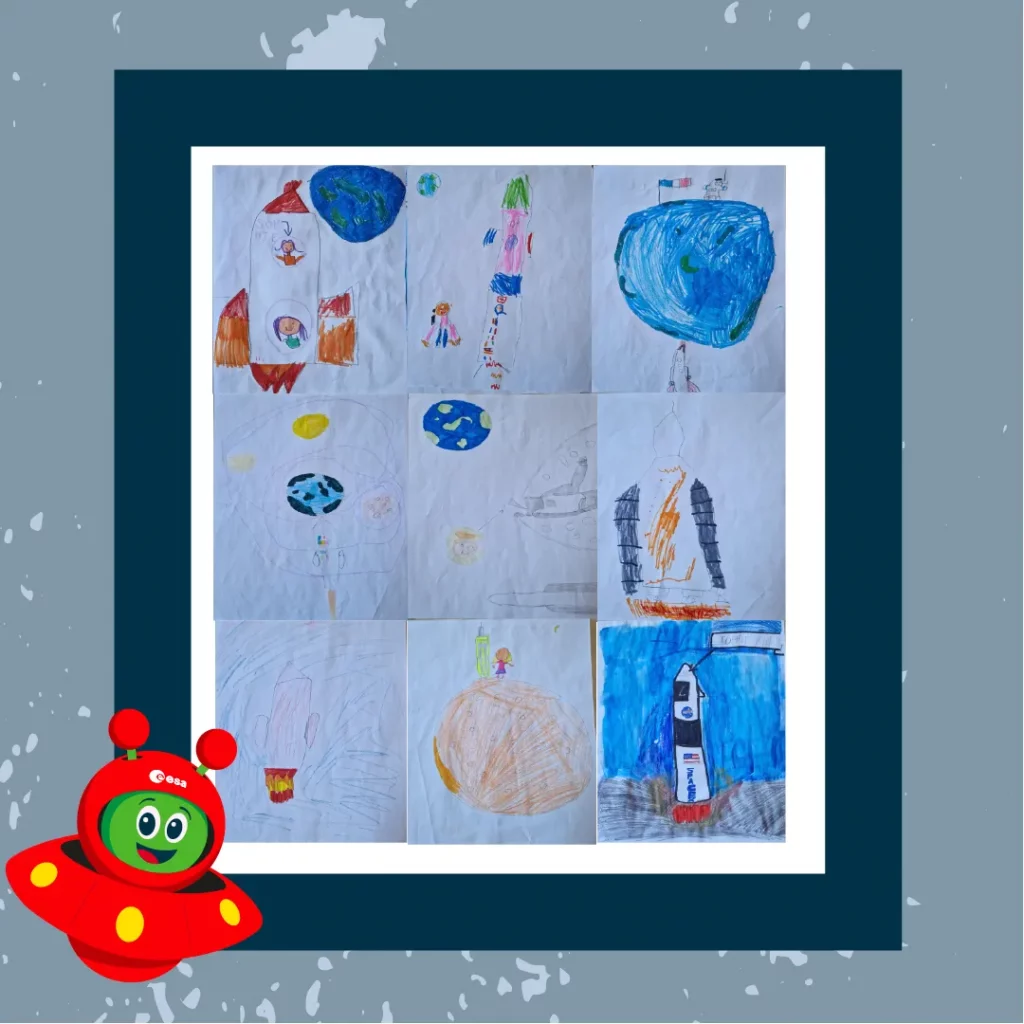
Congratulations to our February winners!
For the February challenge on ‘Science in Space’, ESA has selected the drawings from La Petite Bibliothèque Ronde from among the winners. Paxi and the whole ESERO France team would like to congratulate you on these wonderful drawings illustrating how to do science in space!